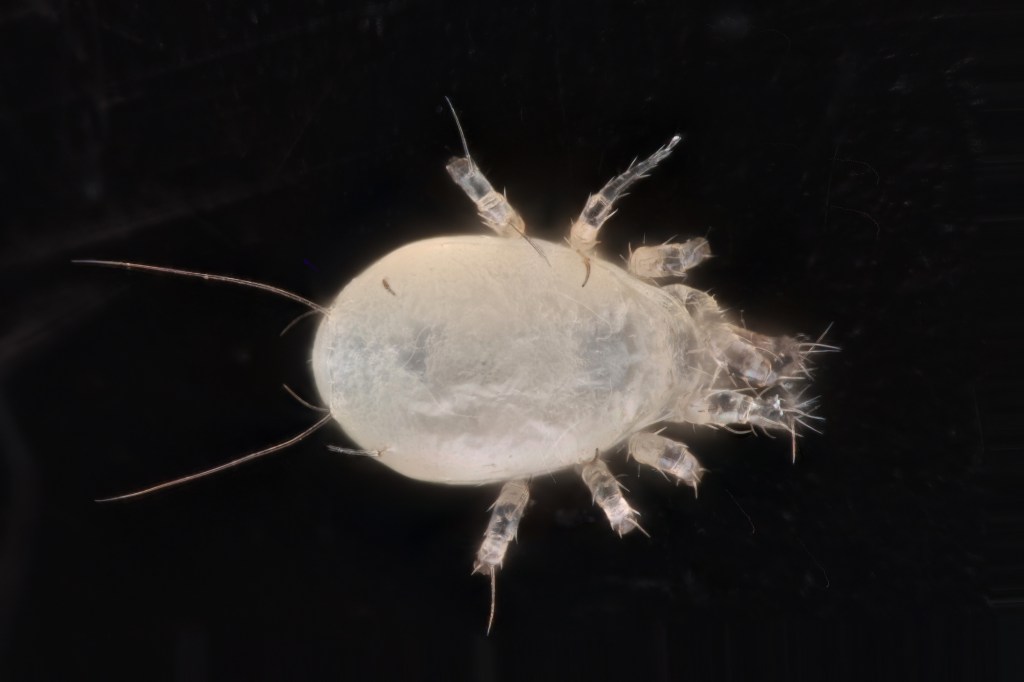
Kin recognition is widely observed in the animal kingdom. Individuals discriminated between relatives and non-relatives to avoid inbreeding and increase their inclusive fitness. Members of Phytoseiidae (Acari: Mesostigmata) are important biocontrol agents against phytophagous mites and insects. In a preliminary study, the thelytokous phytoseiid Amblyseius herbicolus was observed for its kin discrimination ability. Therefore, three laboratory experiments were conducted to examine kin discrimination further and determine the adaptive functions in A. herbicolus. Asexually reproduced species would be genetically similar to their mother compared to sexually reproduced ones making them difficult to discriminate between close relatives. Therefore, the first experiment investigated kin recognition and cannibalism among relatives. Relatively fine discrimination was observed, where A. herbicolus mothers reluctantly cannibalised their daughters in the presence of first or second cousin’s larvae. The second experiment examined the influence of early social interaction on kin discrimination and cannibalism at the different ontogenetic stages of A. herbicolus. Only ovipositional A. herbicolus females avoided cannibalising siblings when non-siblings were present. Early social experiences between siblings reduced the propensity to cannibalise in A. herbicolus but did not influence kin discrimination. The third experiment examined kin discrimination and oviposition site preference of A. herbicolus. When two choice sites contained either their own eggs or eggs laid by non-kin, A. herbicolus mothers preferred to oviposit near eggs of non-kin in the absence of food (Carpoglyphus lactis eggs), but showed no preference when food was given at both sites of choice. The difference in hunger and resource availability influenced kin discrimination of ovipositional A. herbicolus females but not early social experience with siblings. Ovipositional A. herbicolus females were likely to familiarise their eggs’ characteristics and use them in later discrimination to avoid cannibalising offspring and select oviposition sites to reduce sib competition and cannibalism. The findings of this study provide insights into the understanding of kin recognition and how various biotic factors influence kin discrimination. A cost and benefit evaluation might be processed by individuals capable of recognising kin, whereas kin discrimination only occurs under the circumstances with sufficient benefit.
Research output
- Zhang, K. & Zhang, Z.-Q. Social context during ontogeny affects cannibalism and kin recognition of the predatory mite Amblyseius herbicolus at different life stages. Experimental and Applied Acarology 88, 317–328 (2022).
- Zhang, K. & Zhang, Z.-Q. A thelytokous predatory mite is more cannibalistic towards distant kin. Current Zoology 69, 578–584 (2022).
- Zhang, K. & Zhang, Z.-Q. Amblyseius herbicolus mothers prefer to oviposit near eggs of non-kin in the absence of prey Carpoglyphus lactis (Acari: Phytoseiidae, Carpoglyphidae). Systematic and Applied Acarology 27, 2347–2354 (2022).
- Zhang, K. & Zhang, Z.-Q. Kin recognition by cannibals is modulated by hunger level in a generalist predatory mite Amblyseius herbicolus (Chant) (Acari: Phytoseiidae). Journal of Applied Entomology 146, 579–585 (2022).
- Zhang, K. & Zhang, Z.-Q. The dried fruit mite Carpoglyphus lactis (Acari: Carpoglyphidae) is a suitable alternative prey for Amblyseius herbicolus (Acari: Phytoseiidae). Systematic and Applied Acarology 26, 2167–2176 (2021).
 miteykeshi.blog